Your shopping cart is currently empty.
If you have not already done so, you can login to your account to see any items that may be saved in your cart. Once logged in, you may also add items to the cart that you saved previously to your wishlist.

by Dr. Morgan Davis
23 March 2026
If you are renting a clarinet or saxophone for the first time, buying reeds can feel like an unnecessarily confusing process. What do the numbers on the box actually mean? How do you know when it is time to move up to the next size? We put together a quick, essential guide to explain reed strength and help you buy with confidence.
If you are new to single reed instruments, such as clarinets and saxophones, there is a lot of information about reeds out there for you to sort through. The reed is one of the most important pieces of equipment, as it is the vibration of the reed against the mouthpiece that creates the sound. You will need to purchase reeds regularly, and if you are feeling a bit overwhelmed looking at boxes labeled with numbers like 2.0, 2.5, or 3.0, you are not alone! Here is the essential information you need to know to buy reeds with confidence.
A simple flow chart for choosing reeds looks like this:
Size (or instrument) → Brand → Strength
“Size,” while the most critical, is also the most straightforward. If you need reeds for a tenor saxophone, buy reeds labeled “tenor saxophone.” Trying to use an alto saxophone reed to play a tenor saxophone will not produce desirable results as they are not the right length, width, or thickness for a tenor saxophone mouthpiece. Because of this, the size of the reed is often simply referred to by the instrument for which it was made. For instance, searching for “tenor saxophone reeds” will yield results that should be the right size for any standard tenor saxophone mouthpiece.
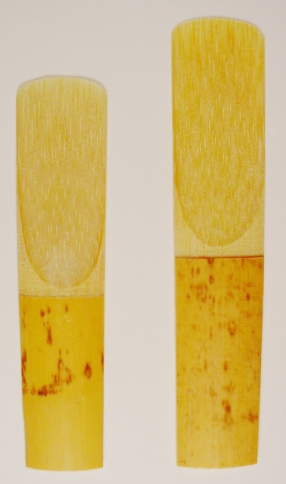
“Brand,” while important, is not as critical as selecting the right size and strength at first, provided you choose a brand from a reputable manufacturer (such as D’Addario or Vandoren). There are many available options, and the reasons why one may prefer a specific brand are vast and is the subject of its own article.
Reed “strength” represents the relative flexibility of the cane. More flexible reeds are referred to as “soft” reeds by musicians, while less flexible reeds are referred to as “hard” reeds. Most manufacturers use a numbering system typically ranging from 1.0 (softest) to 5.0 (hardest), moving in half-step increments. All reeds within a specific size and brand (e.g. alto saxophone Vandoren Traditional reeds) are carved to the exact same dimensions. A 2.0 is not physically thinner or smaller than a 4.0. Once a reed is carved from a blank piece of cane, specialized machines test its natural flexibility. Based on how stiff that specific reed is, it is then categorized, sorted, and stamped with its corresponding strength number. However, not every reed in a box of 2.5 reeds will feel the same. Since reeds are carved from a plant, there are naturally occurring irregularities in the cane that can make the playing experience slightly different from reed to reed despite having the same flexibility designation. Further complicating “strength” is that a 2.5 for one brand might not have the same flexibility as a 2.5 for a different brand, even one made by the same manufacturer.
When a student is just starting out, they need a reed that vibrates easily and does not tire out their muscles so they can successfully produce a sound without becoming frustrated. Most band directors and private teachers recommend beginners start with a 2.0 or 2.5 strength reed. Softer reeds are easier to play. Those strengths are the “sweet spot” of tone and playability for most beginning students using standard entry-level mouthpieces and reeds. This allows the young musician to focus on learning fingerings and reading music rather than fighting their instrument.
You feel less resistance when playing softer reeds. This means you need to create less air pressure to start the reed vibrating than you would for a harder reed. Additionally, the embouchure (facial muscles) needs less physical strength to control the reed. As your skills develop and your physical air and embouchure strength increase, a 2.0 or 2.5 will likely be too soft if you are still on an entry-level mouthpiece and will start to inhibit your musical development.
The answer is: it depends on the musician! Most students need to move up a half strength at a time until they find the right strength for their mouthpiece and body, which is a continuous process as their embouchure muscles develop and their ability to move air through the instrument improves. After a few months, changing from a 2.0 to a 2.5 might suit them. After a few more months, they may need to move from a 2.5 to a 3.0. Every musician is different, but most students who start on a 2.0, practice regularly, and get regular instruction should expect to change to a 2.5 within their first six months of playing.
To know exactly when it is time, you need to trust your ears (and your teacher’s ears) as well as the physical feeling you have when playing your instrument. For most players on the most common entry-level clarinet or saxophone mouthpieces, a 2.5 to a 3.5 strength reed for the most common brands offers the best balance of rich and full tone, control, and dynamic range. It is worth noting that playing on a higher number reed strength does not mean you are a better player. Reed strength is not a score or a grade. Again, it is simply a representation of the cane's natural flexibility. A professional might play on a 2.5 or a 4.0 depending on their specific mouthpiece or the genre of music they play.
How do you tell if a reed is too soft? You will usually notice a few common signs, such as tone that sounds “thin” or “buzzy,” or intonation that is consistently flat. The reed might close up against the mouthpiece when trying to play loud, and high notes are very difficult to get out.
How do you tell if a reed is too hard? You will usually notice a “muffled” or “airy” tone, intonation that is consistently sharp, or your embouchure muscles becoming fatigued far quicker than usual.
There is some variation within a box of identically labeled reeds. The above signs should be consistently experienced on multiple reeds over a period of time. When changing reed strengths, allow for an adjustment period. When you first move to a harder reed, you will likely experience all of the signs that the reed is too hard. If you do need a harder reed, those problems will get better. Rotate through 3-4 reeds of the new strength each time you play for at least a week to give yourself time to adjust to the different physical demands and to account for any inconsistencies within the box.


© 2011-2026 Ellis Music Company Inc. All Rights Reserved. Powered by AspDotNetStorefront.
Prices displayed on this site are for in-stock quantities only and are subject to change without notice. Sorry, but typographical errors in prices cannot be honored.
General Site Disclosures